

Storm Damage Tree Removal: What to Do After a Michigan Storm
We all know how fast Michigan weather can change.
One minute, everything is calm. The next, high winds, heavy rain, lightning, ice, or snow can scatter branches across your yard or leave an entire tree lying across your driveway, garage, or home.
When that happens, knowing what to do next matters.
Storm damage tree removal is different from taking down a healthy tree under normal conditions. Damaged trees can be unstable, branches can fall without warning, and trunks or roots may be under tremendous pressure.
That means your first priority has to be you and your family’s safety.
At Trumpp Tree Service, we help homeowners throughout Oakland County and surrounding communities deal with damaged, fallen, and hazardous trees after severe weather. Here's what you should know before you start cleaning up.
Key Takeaways
Stay away from fallen trees or branches touching power lines.
Have a tree that suddenly leans, uproots, splits, or loses major limbs professionally evaluated.
Don't assume a damaged tree needs to be removed; some can be saved with proper trimming.
Never attempt to cut a storm-damaged tree that's leaning, suspended, or resting against a structure yourself.
Take photos of property damage before cleanup if you may file an insurance claim.
Homeowners insurance may cover certain tree removal costs, depending on your policy and what the tree damaged.
Fast professional help can prevent an unstable tree or branch from causing additional damage.
What Should You Do Immediately After a Storm?
Before worrying about the mess in your yard, look for immediate hazards.
From a safe distance, check for:
Fallen or hanging power lines
Trees leaning toward your home
Large branches hanging overhead
Split or cracked trunks
Uprooted trees
Trees resting against your roof, garage, fence, or another tree
Large limbs blocking your driveway or access to your home
If a tree or branch is touching a power line, do not approach it. Don't try moving the branch. Don't start cutting. Don't assume the line is dead because your power is out.
Keep everyone away from the area and contact your utility company.
If there aren't electrical hazards, you can document the damage from a safe location. Take pictures and videos before moving anything, especially if a tree damaged your house, garage, fence, shed, or other property. Then call a professional tree service.
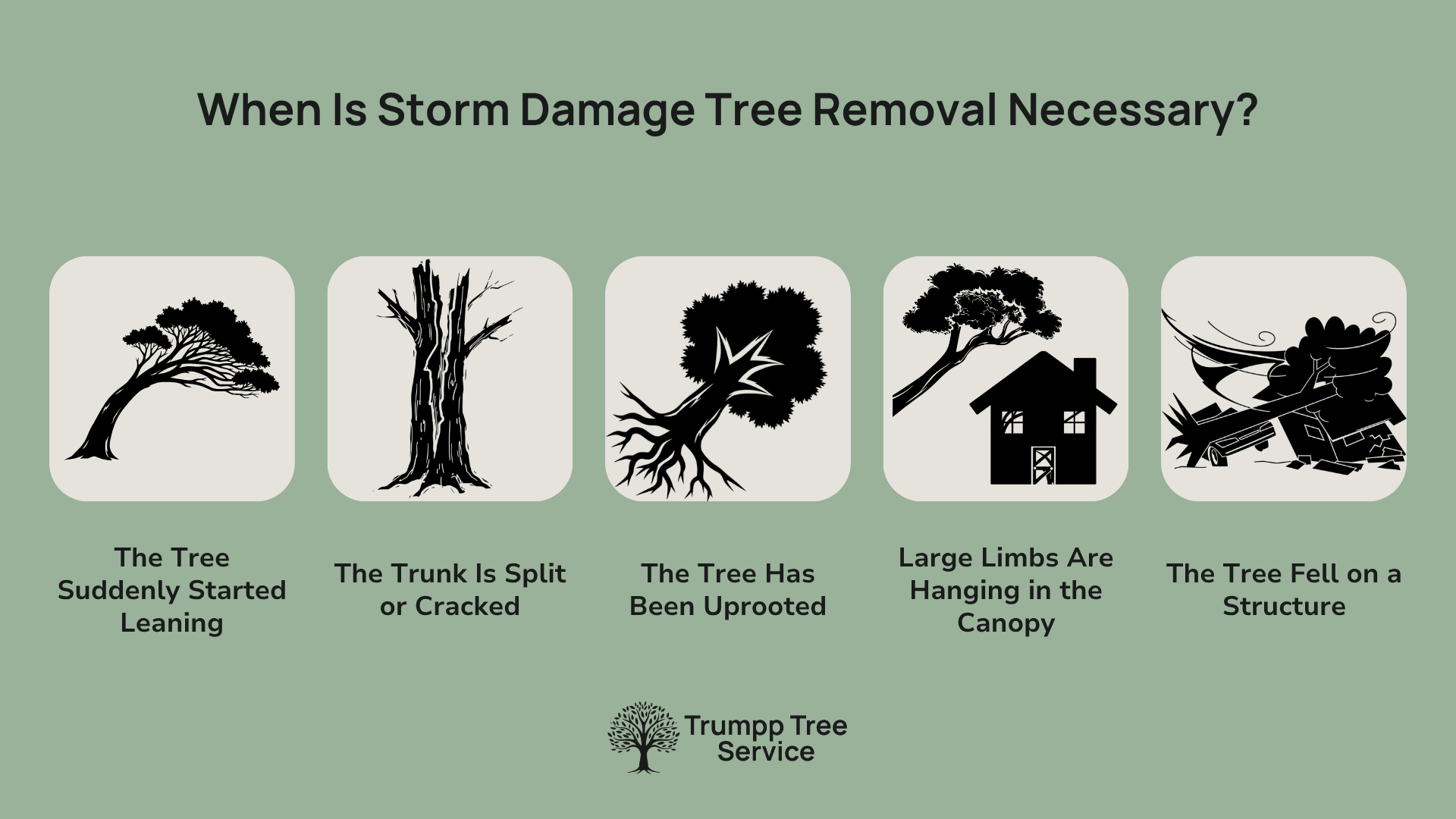
When Is Storm Damage Tree Removal Necessary?
Not every damaged tree has to come down.
A tree that loses a few smaller branches may only need professional trimming. Even some trees with significant damage can recover if the trunk and root system remain structurally sound.
Other trees aren't so lucky.
The Tree Suddenly Started Leaning
Some trees naturally grow at an angle. That's different from a tree that was standing straight yesterday and is leaning after a storm today.
A new lean can indicate that the roots have shifted or partially pulled out of the ground. Look at the soil around the base.
If you notice lifted soil, exposed roots, or the ground heaving on one side, stay away from the tree and have it inspected as soon as possible.
The Trunk Is Split or Cracked
A major crack or split can compromise the tree's structural strength. This is especially concerning when the split extends through the trunk or occurs where two large sections meet.
A damaged trunk may continue supporting the tree temporarily, but that doesn't mean it's stable.
The next gust of wind could bring it down.
The Tree Has Been Uprooted
Heavy rain can saturate Michigan soil while strong winds push against the canopy.
Sometimes the root system loses its grip entirely.
Once a large tree has uprooted or partially uprooted, storm damage tree removal is often necessary. The tree may be extremely unstable even if it hasn't completely fallen.
Large Limbs Are Hanging in the Canopy
One of the most dangerous storm hazards isn't always on the ground. It's above you.
Broken branches can remain lodged in the canopy after a storm. They may look secure from below but fall hours or even days later.
Never stand underneath a hanging limb to inspect it.
The Tree Fell on a Structure
If a tree lands on your house, garage, shed, fence, or another structure, don't immediately start cutting branches away.
The tree's weight may be distributed across multiple limbs and sections of the structure. Removing the wrong piece can suddenly shift that weight.
Professional crews can determine how to dismantle the tree in a controlled way while reducing the risk of additional property damage.
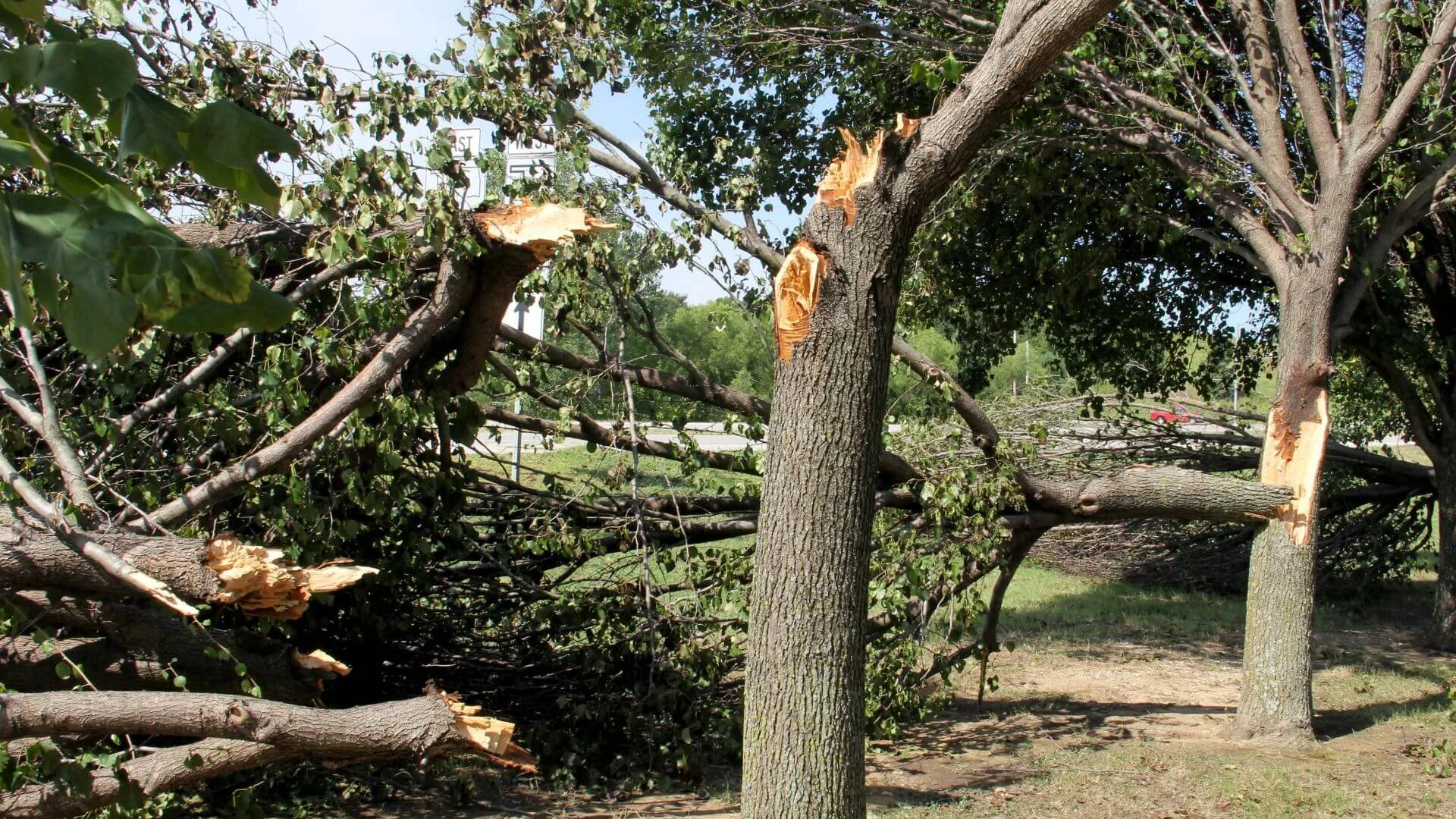
Can a Storm-Damaged Tree Be Saved?
Sometimes! And we're not going to tell you to remove a tree that only needs trimming.
The important question is whether the tree can remain structurally safe.
A professional storm damage tree removal company will look at things like:
How much of the canopy was damaged
Whether major limbs were lost
The condition of the trunk
Whether cracks or splits are present
Root damage
Changes in the tree's lean
Existing rot or decay
The tree's proximity to your home and other structures
Minor storm damage may be addressed by removing broken branches and properly trimming the remaining canopy. More serious structural damage may make removal the safer choice.
Every tree is different. That's why it's worth having someone look at it, instead of assuming a rough-looking tree is doomed or that a standing tree is automatically safe.
Why Storm-Damaged Trees Are So Dangerous to Remove Yourself
We understand the temptation to remove a tree yourself. There's a tree in the yard. You have a chainsaw. You want it gone. Seems simple, right?
But a storm-damaged tree isn't the place to test your DIY tree removal skills.
Damaged trees can behave unpredictably because their structure is already compromised.
Branches Can Be Under Tension
A bent or partially broken limb can store a lot of energy.
Once you cut into it, that pressure can release suddenly, causing the branch to swing, roll, split, or snap back.
Fallen Trees Can Shift
Just because a tree is on the ground doesn't mean it can't move.
A partially uprooted tree may still have tension in its root system. Trees resting against buildings or other trees can also roll or shift as pieces are removed.
Damage Isn't Always Visible
A branch that looks solid from the ground may already be cracked, roots may have shifted underground, and a trunk may be weaker than it appears.
That's why we strongly recommend professional storm damage tree removal for anything beyond small branches and debris safely lying on the ground.
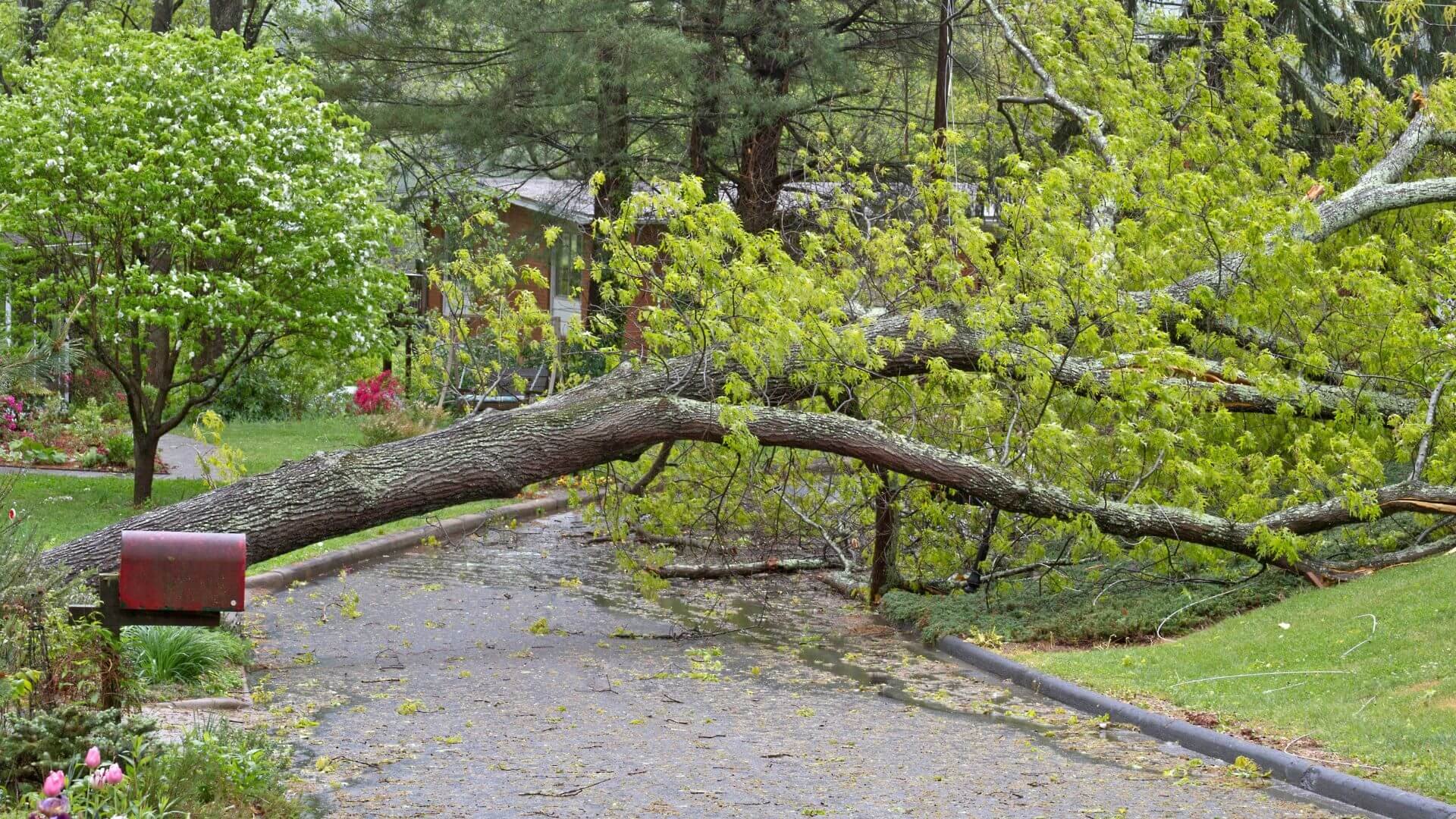
What Happens During Professional Storm Damage Tree Removal?
Every storm job is a little different.
A tree lying in an open backyard isn't the same job as a large oak resting against a roof.
We start by looking at the tree, the surrounding property, and the safest way to approach the work.
Our professional tree removal crew will determine where the tree's weight is resting, which sections are unstable, what structures need protection, and what equipment will be required.
From there, damaged branches and sections of the tree can be removed in a controlled order.
For difficult jobs, the tree may need to be dismantled piece by piece rather than simply cut at the base. Once the dangerous work is finished, we clean up the debris and leave your property tidy.
Because after dealing with a storm, the last thing you need is another mess to clean up.
Will Homeowners Insurance Cover Storm Damage Tree Removal?
It might.
Coverage depends on your homeowners insurance policy, why the tree fell, and what it damaged.
For example, policies may cover a tree that falls because of a covered event, such as wind or lightning, and damages an insured structure, such as your home or garage. A tree that simply falls in the middle of your yard without damaging covered property may be treated differently.
That's why we recommend contacting your insurance company directly instead of assuming something is or isn't covered.
Before cleanup begins, if it's safe to do so:
Take photos and videos of the tree and damage.
Photograph the area from several angles.
Contact your insurance company.
Ask what documentation they need.
Keep estimates and invoices associated with the removal.
If there's an immediate safety hazard, however, don't put yourself in danger trying to get the perfect insurance photo; your safety always comes first.
Can You Prevent Storm Damage to Your Trees?
You can't control Michigan weather. But you can better prepare your trees for it.
Regular tree care can identify problems before the next severe storm rolls through Oakland County.
Watch for:
Dead or dying branches
Cracks in trunks or major limbs
Mushrooms or signs of decay around the base
Trees leaning toward structures
Weak branch connections
Large branches hanging over your roof
Changes in the soil around the roots
Regular tree trimming can also remove dead or weak branches before high winds have a chance to do it for you.
If something about a tree doesn't look right, don't wait for the next thunderstorm to find out how strong it is. Have it checked.
Storm Damage? Call Nick the Tree Guy
A severe storm is stressful enough without having to figure out how you're going to get a tree off your property.
We'll handle the dangerous part.
Trumpp Tree Service provides storm damage tree removal and emergency tree services throughout Oakland County, including Clarkston, Rochester, Waterford, Bloomfield, Milford, Auburn Hills, and surrounding communities.
Our experienced crews know how to handle hazardous trees safely while protecting the property around them. We're licensed and insured, carry workers' compensation coverage, and have more than 20 years of combined experience.
And when the tree is gone, so is the mess.
If a storm has left you with a fallen tree, hanging branches, or a tree you're not sure is safe, call Trumpp Tree Service today for a free quote.
We can often be there within hours.
